
Data-backed School Improvement, Powered by Student Leadership
When given the opportunity and trust to lead, students become co-creators of change that led to is grounded in empathy, collaboration and a shared purpose.
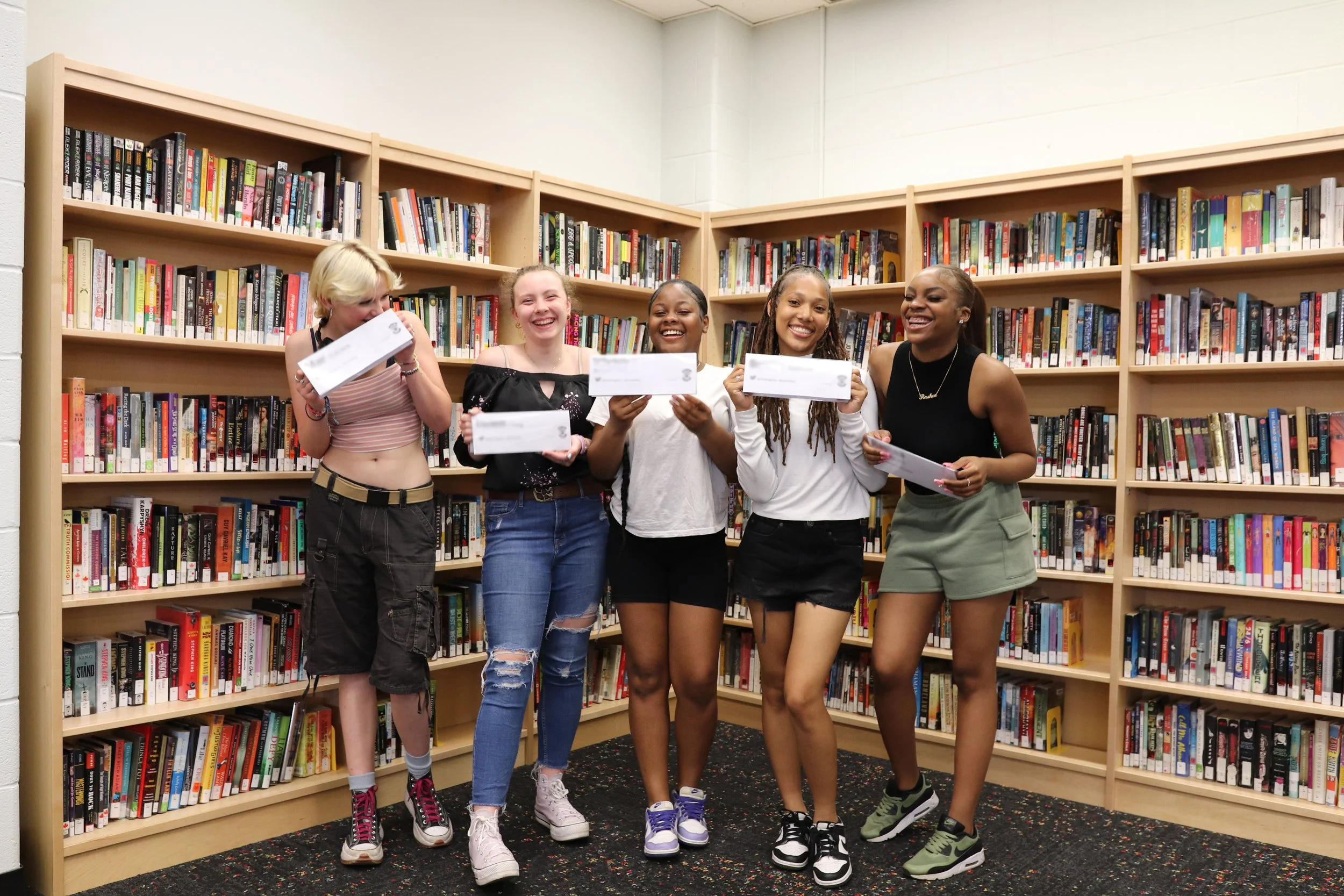
In the five years from 2021 to 2026 Central Technical School’s (CTS) Ontario Secondary School Literacy Test scores jumped by 27%. Suspensions plummeted. The Fraser Institute rating moved from 0.2 to 4.2, naming CTS as proof that all schools can improve, regardless of barriers to achievement (Cowley, 2025). But more than test scores, the culture transformed: attendance stabilized, students became assessment-literate, asking for feedback rather than points or marks, and classrooms became hubs of engagement instead of places students ran from.
This transformation began with new Principal Anne Chirakal asking students, teachers, staff and community members what CTS was all about. Their answers varied. With over 1,000 students from 100 feeder schools, in 2021, there was no alignment on the identity of the school.
Watch Anne’s talk on her bold moves for school improvement, and read below for I-Think’s work with students to create the school strategy.
Central Technical School’s Strategy
Central Technical School’s Strategy was created by 12 high school students. When you read it, know that we put tape recorders in front of the students and had that transcribed. The words you read are their words:
We believe that Central Technical School can be a place of exceptional student learning.
Our Vision is that Central Technical School is a place where all students leave with:
A love of learning
The real-world skills to choose their next steps
A strong sense of self and others
To be this, Central Technical School needs to be a place of:
Student-centered imagination and action
Cultural enlightenment
Safety
Co-creating this future - where our Vision and Mission are real - requires us to dive into the complexity of change. We used Pro-Pro Charts and Causal Models to look for leverage points: where the CTS community should concentrate our efforts and actions for the highest impact. We identified six areas for action.
We treat each other as precious
Adult knowledge and imagination to ensure a learning culture for all
Assessment that honours the brilliance and the diversity of learning journeys of students to ensure choice in their next steps and experience
Shared power and responsibility to keep what’s good working, and take actions on what is not
Access to a diversity of adults to affirm the many identities of students and adults
Advocating to change the inequities in the Toronto District School Board to have the ability to make choices that best support our vision
The students wrote directly to their peers and to the adults in the building. They called out systemic flaws while expressing belief in what was possible. “School and learning can be joyful and how you find your purpose. [Students] deserve to enjoy learning and have CTS be where your interests and passions come alive,” they wrote to fellow students. To adults, they extended an invitation: “Your expertise and lived experience, and our needs, expertise, and lived experiences; it’s not one or the other. It’s both.”
Why this matters
After more than a century since the school’s founding, Central Technical School reached a turning point in 2022. Returning from Covid measures, staff and students were grappling with questions of identity and direction: Was CTS a tech school, an arts school, an experiential learning hub? Central Technical School also faced deep academic and cultural challenges: high suspension rates, chronic absenteeism, and a high failure rate among Grade 9 students, a quarter of whom required intensive literacy support. Over 400 students had IEPs without strong transition plans, and many older students arrived with few credits. Student feedback revealed concerns about racial equity, underrepresentation among staff, and a school culture that needed to better reflect and support the diversity, aspirations, and well-being of its learners.
Instead of accepting this norm, Principal Anne Chirakal and a group of twelve students partnered with I-Think to reimagine the school’s future.
Three years later, what started as a question of identity, has grown into a living model of what happens when students are at the centre of change. At CTS, this looks like the opening of a new Student Leadership Room that now anchors student support and connection, every student receives a letter from a caring adult, and a Podcast Studio gives students safe spaces to share their voices.
In classrooms, assessment has shifted from high-stakes exams to no exams in grades 9 and 10. Instead, offering feedback centered on growth, with teachers and students co-creating learning maps and focusing on reflection and real-world application. CTS has strengthened its support model so that every student is connected to a caring adult who can provide help with academics, well-being, and attendance. Students have become central to community learning by leading initiatives like Freedom Fest, Black Love Day and Pride Ball, and extending school partnerships to organizations like BEE, City of Toronto, CAMH, CTYS, St. Stephen’s House, UIEC, PEERs, High5, I-Think, Peacebuilders, and Pathways. When students received stronger support, it translated into measurable academic gains.
For the original 12 students, their teachers noticed a change in behaviour. Students were asking deeper questions, persevering through challenging tasks, and considering multiple perspectives before forming opinions. They became more open, resilient, and curious learners.
What we did
I-Think brought together the Playing to Win Strategy framework and Real-World Problem Solving Journey, rooted in Integrative Thinking and human-centered design, to facilitate student thinking. The process we facilitated:
1 - Frame the Problem
To Frame the Problem, students led focus groups and conducted ethnographic interviews with educational leaders, to surface insights into the future of teaching and learning.
Students interviews included:
Anne-Marie Longpre, Teacher, Toronto DSB
Colleen Russell-Rawlins, Director of Education, Toronto DSB
Mike Gallagher, retired Superintendent of Education, Toronto DSB
Nick Bertrand, Education Officer, Ontario Ministry of Education and former Indigenous Education Lead
Rachelle Bloomfield, Restorative Schools Coordinator, Peacebuilders Canada
Sakaana Yasotharan, former Toronto DSB Student and Toronto Metropolitan University Graduate
The group then grouped data and identified connections and themes across the focus groups.
Doing this, students named their Vision and Mission.
Next, students developed the school’s strategy.
2 - Drive for Insights
Students used the Causal Model and Pro-Pro Chart frameworks to explore leverage points for meaningful change
Causal Models use cause-and-effect logic to understand why something happens or how to create an outcome. Students created Causal Models for each part of the vision and mission to identify leverage points as areas of focus.
The Pro-Pro Chart makes explicit what's good about each opposing model for different people to identify what matters most. Students used the Pro-Pro Chart to think through tensions that might prevent the school taking action.
Students created the How to Win of their strategy:
3 - Building Better Models
Students brainstormed actions and commitments that would bring their vision to life.
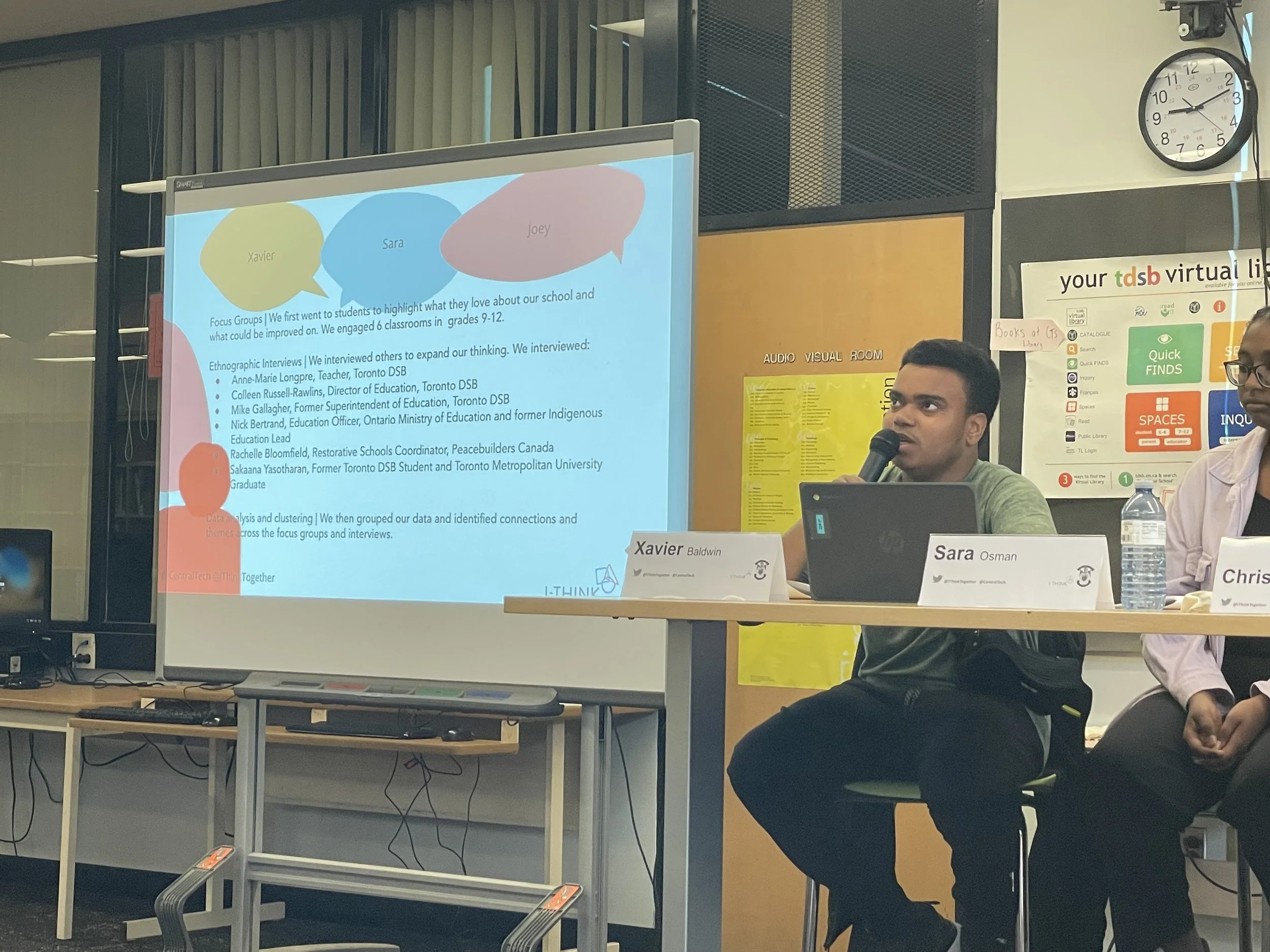
Students presenting to 100 staff at Central Technical School
Ensuring Sustainability For Continued Impact
This was never going to be a one-time exercise. Now in its fourth year, this has become the school’s Student Leadership Group. The Group has established a rhythm of annual cycles where students tackle problems, test solutions, and take action on issues that matter most to them. These challenges have ranged from implementing the cellphone policy, to how sports are financially supported at the school, to student recruitment, to co-constructing the learning environment. Each year builds on the last, embedding accountability and imagination into the fabric of the school.
“We’re doing this for future generations, as well as ourselves, so they don't have to go through what some of us have gone through, with our identities being told that they're wrong, or dealing with discrimination for any sort of reason and feeling uncomfortable in a space where we're supposed to learn.” - Christina
