

Real-World Problem Solving at Central Technical School
On this site you will find all the materials from our learning together. The Zip File below has copies of the materials from the program.
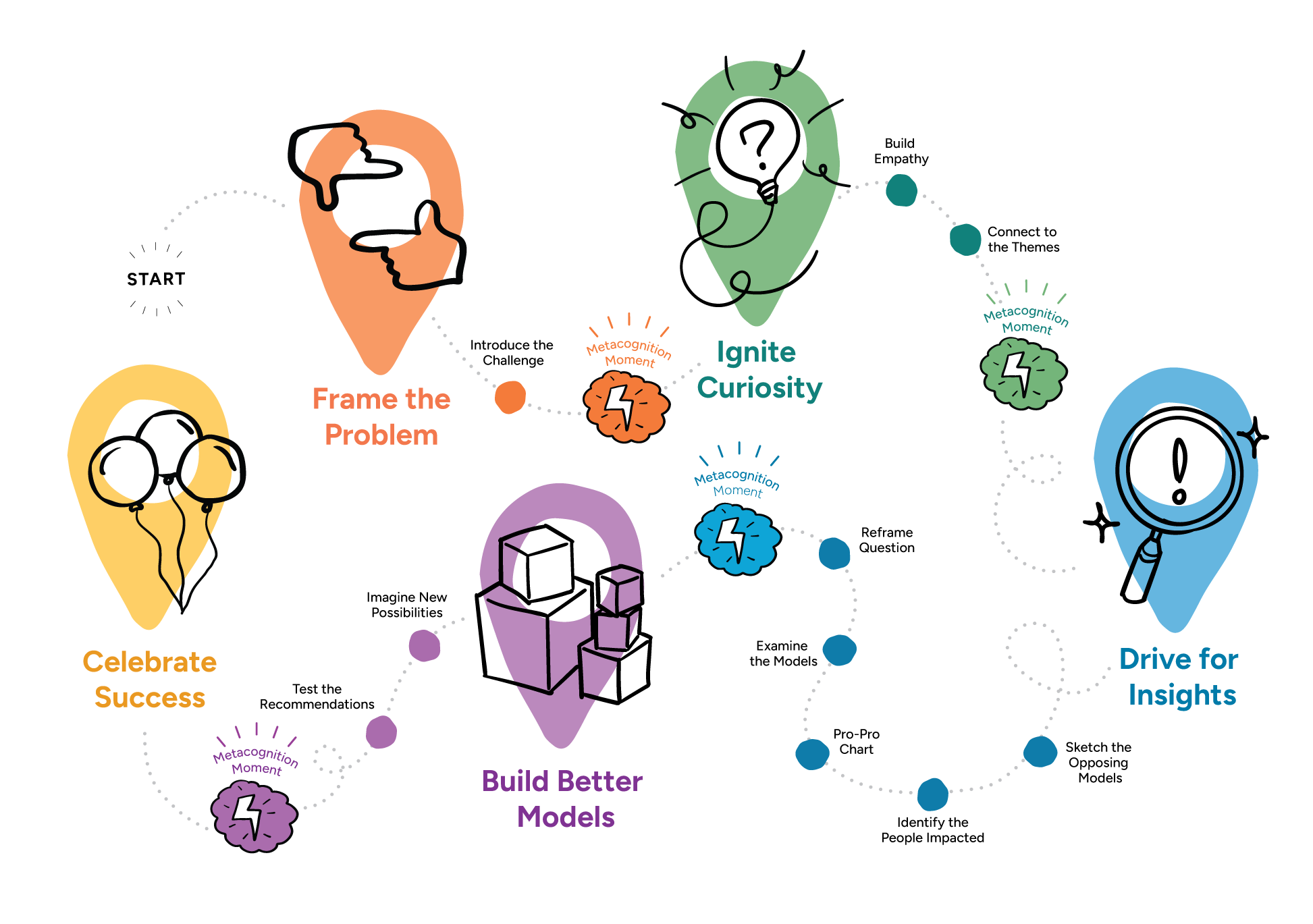
From 2024 - 2026 we learned and practiced the Real-World Problem Solving Journey, underpinned by Integrative Thinking. This program was a chance for us to dive into theories of thinking and creativity (in practical ways that you can use with students!), practice frameworks for real-world problem solving and design learning experiences for the students in your classrooms and schools.
At I-Think, we focus on real-world problem solving because it develops the skills and mindsets students need for now and the future—it’s how we build optimistic, tenacious and confident problem solvers. Make your classrooms and schools the place students learn that the world can be different and that they can solve some of its most complex problems.
To watch videos from the 2026 Institute and to share shorter videos for each tool with colleagues visit the Professional Development page.
Pro-Pro
The Real-World Problem Solving Journey is underpinned by the methodology of Integrative Thinking. Integrative Thinking is defined as “the ability to face constructively the tension of opposing ideas and, instead of choosing one at the expense of the other, generate a creative resolution of the tension in the form of a new idea that contains elements of the opposing ideas but is superior to each.” — Roger Martin, The Opposable Mind
Ladder of Inference
The Ladder of Inference is a thinking framework, developed by Chris Argyris, that slows down thinking to support metacognition. The Ladder of Inference breaks down how we build our models into data, interpretation and conclusion. Doing this as a team gives space to see what data might be missing, different ways of interpreting that data and coming to multiple conclusions.
An example we discussed from the classroom of Jennifer Warren: You can guide students through a Ladder of Inference by first watching the video on mute and drawing conclusions based only on the visuals. Then, watch it again with the lyrics to compare how the added context shifts interpretations and conclusions.
In one of our workshops, we used the watershed challenge from the Toronto and Region Conservation Authority. This video sets up the challenge.
Causal Model
The Causal Model is a framework to understand our theories and build new ones by diving into the complexity of the situation. Causal Models help us understand what is causing a problem, or what will cause us to achieve a desired solution. From there we can decide on areas for action. The Causal Model stops a group from simplifying the problem and their thinking by leveraging the experiences and knowledge of everyone around the table for deciding next steps.
Providing Feedback on a Causal Model
When providing feedback on a Causal Model, look for:
1) Nodes are a complete thought | Each node should contain enough detail to clearly communicate an idea. Look for specificity and actionability. For example, "Apply knowledge to new problems" is stronger than "Understand information."
2) Arrows reflect causation | Each arrow should represent a true cause-and-effect relationship, not just a sequence or correlation. A useful test: can you read the connection as a sentence? For example, "Studying hard causes understanding information". Does that actually hold up?
3) Leaps in logic | Flag places where a causal connection jumps too quickly, skipping over necessary steps. Ask: what's missing between these two nodes? In the example below, the leap from Study Hard to Understand Information is not well-supported. What actually bridges those two?
Study Hard → Understand Information → Do well on assessment → Get a good grade
A student might need to reframe "Study Hard" (into what kind of studying?) or add intermediate nodes like "Use active recall strategies" or "Review and apply feedback from past work."
4) Embracing complexity | A strong causal model goes beyond a single linear chain. Look for feedback loops (where an effect circles back to influence an earlier cause) and nodes with multiple incoming causes. If everything flows in one straight line, prompt the student to consider: What else contributes to this? Does any outcome loop back and affect something earlier?
All examples above are drawn from a causal model about earning a good grade in a class.
Success Criteria
We brainstormed possible Success Criteria you can use with the Causal Model. Thank you to everyone who contributed to this list.
I can show cause and effect links (fill in the blank of the curriculum)
I can expand my understanding of (fill in the blank of the curriculum)
I can articulate the specificity and nuance of my thinking
My thinking demonstrates an understanding of knowledge
I can apply my understanding to a real world situation
I can analyse my thinking in relation to (fill in the blank of the curriculum)
I can brainstorm and identify many complex causes
I can use my thinking for (fill in the blank of the curriculum)
I can use my experience to demonstrate an understanding of (fill in the blank of the curriculum)
I am open to different perspectives
I can synthesize multiple perspectives on (fill in the blank of the curriculum)
I am writing to engage with different perspectives
I ask questions about our understanding of (fill in the blank of the curriculum)
I can critically analyze my own thinking on (fill in the blank of the curriculum)
I can support my thinking with evidence/data/lived experience
I can effectively analyze and dissect complex information into clear, relevant components to support my understanding and decision-making