
School Improvement is Strategy
School Boards need ways to support every school at scale to succeed at school improvement. We helped two Ontario school boards build frameworks that put this into practice in every school.
Six Key Conversation at the Toronto District School Board
In 2016, senior leaders at the Toronto District School Board (TDSB) came together to create a school improvement framework to use across the system. I-Think facilitated the process that built it.
The framework is rooted in 6 conversations, leading to its title: Six Key Conversations. They are a series of conversations that loop, after the 6th conversation, you return to the 1st. It reflects how School improvement isn't something you write at the start of the year, submit, and rewrite the following September.
For each conversation, the framework included:
A description of its purpose
Inputs required for the conversation to be effective
Resources
Guiding questions
A conversation about data asked what kind of data matters, looked for disconfirming data, and used the Ladder of Inference to test how we get from data to conclusions. A conversation about action used the Pro-Pro Chart to navigate the benefits of opposing options.
The Six Key Conversations became the anchor for Learning Network Meetings.
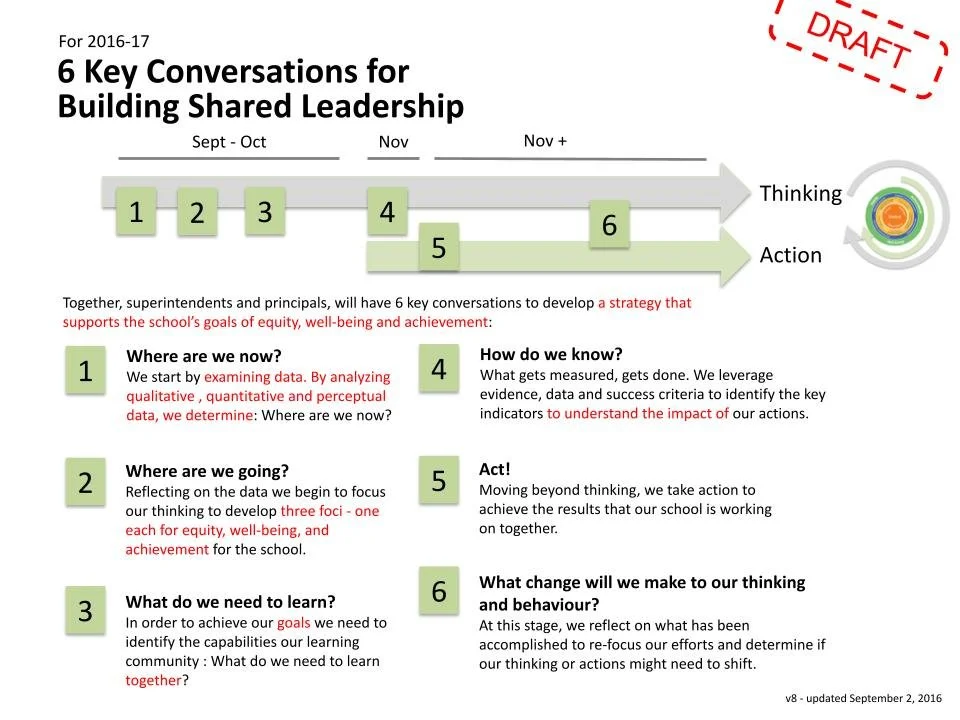
Version 8 draft of the Six Key Conversations, Sept 2016
Keewatin-Patricia District School Board: Playing to Win, adapted
Keewatin-Patricia District School Board (KPDSB), in northern Ontario, wanted a school improvement framework that all 43 of its schools could use. With the leadership of Superintendent Shannon Bailey, I-Think facilitated a group of principals and vice principals to build it.
We started by listening. Through open-ended ethnographic interviews, principals and vice principals told us what they needed from school improvement: where they felt most supported, and where they felt stuck and confused.
From there, we adapted Roger Martin’s Playing to Win framework. The biggest change to the framework was the entry point. Playing to Win starts with Winning Aspiration, but KPDSB leaders wanted to start with data. Data tells a school where to focus, which makes it a Where to Play choice. So we flipped the first two choices:
Where to play: data analysis. Understanding where the school is succeeding and where improvement is needed.
Aspirations: school improvement goals. Setting the goals the school will work toward.
How to win: theory of change. Deciding where to focus action and attention.
Capabilities: support for people. Identifying what teachers, school staff and community need support with.
Management systems: infrastructure. Putting in place the systems that support capabilities, the theory of change, and tracking progress.
The framework was presented to every principal and vice principal in the board and used in every school.
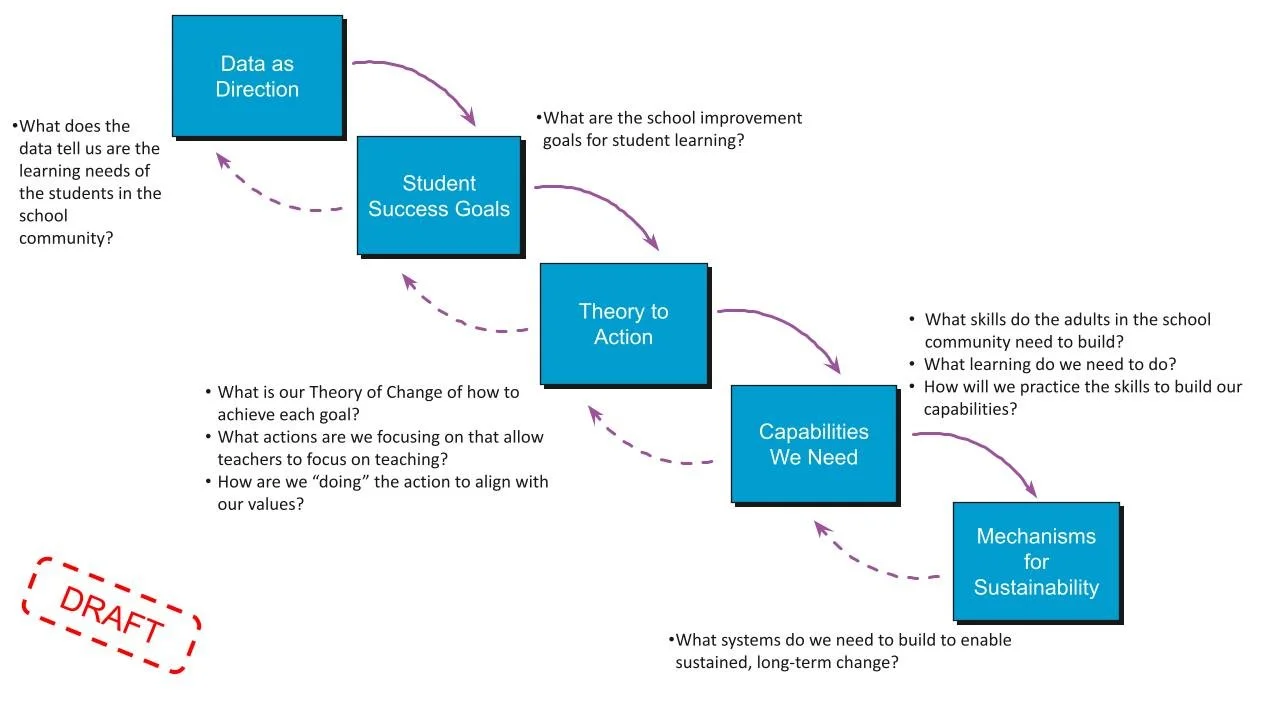
Draft of creating the guiding questions for each choice.
Both frameworks supported the idea that a core skill of principals and vice principals is to think strategically. No school and no leader can do everything. Thinking strategically means focusing. It means deciding what happens now and what must wait. It means that schools can set their own course, and not react to every change that lands on their desk.
