
Real-World Problem Solving Institute
Tuesday, August 18th and Wednesday, August 19th, 2026
9:30am - 4pm EST
Virtual on Zoom
Fee: $29
For teachers, leaders and anyone who works with young people.
Our Approach
Young people face unprecedented challenges, from global conflicts, to climate action, to the relentless pressures of social media. It’s no wonder anxiety and depression are on the rise. But there’s hope. Research shows that fostering student agency, with the skills and mindsets necessary to navigate these complex realities, positively influences their perspectives.
Our approach is simple yet powerful: we equip students with the problem-solving skills they need to thrive in a complex world. Why? Because we believe that every young person deserves the tools to navigate life with resilience and purpose.
We use a replicable process - called Integrative Thinking - to bring real-world problem solving to every K-12 classroom. Integrative Thinking is a creative problem solving methodology that helps us move through the complexity of the problem without being overwhelmed by it. It can also be practiced in any subject area in bite-size pieces.
We focus on real-world problem solving because it develops the skills and mindsets students need for now and the future— it’s how we build optimistic, tenacious and confident problem solvers. Make your classrooms and schools the place students learn the world can be different and that they can solve some of its most complex problems.

In this hands-on series, you will:
✅ Learn the Real-World Problem Solving Journey and practice the tools of Integrative Thinking that underpin it
✅ Explore the theoretical underpinnings of the pedagogy
✅ Hear from I-Think Mentors about their experiences with students and colleagues
✅ Explore how you want to use the tools next school year.
✅ Have a real-world problem activity for your students to work through in the first 6 weeks of school
Workshop Structure
Day 1
Introduction to Integrative Thinking
Get to know your learning partners as we introduce the Integrative Thinking process, real-world problem solving and mental models.
Day 2
Deeper Dive into Mental Models
After answering your questions from Day 1, we share more research on and examples of mental models, including ones from teachers in K - 12 classrooms.
Guided Example
Guided by your facilitators, and using a case study from a classroom, we wrestle with real-world tensions using the Pro-Pro Chart to define, articulate, examine our mental models.
Critical Thinking with the Ladder of Inference
We use the Ladder of Inference to make our and others' thinking explicit and question that thinking. Developed by Chris Argyris, the Ladder of Inference breaks down how we build our models into data, interpretation and conclusion.
Hands-On Experience
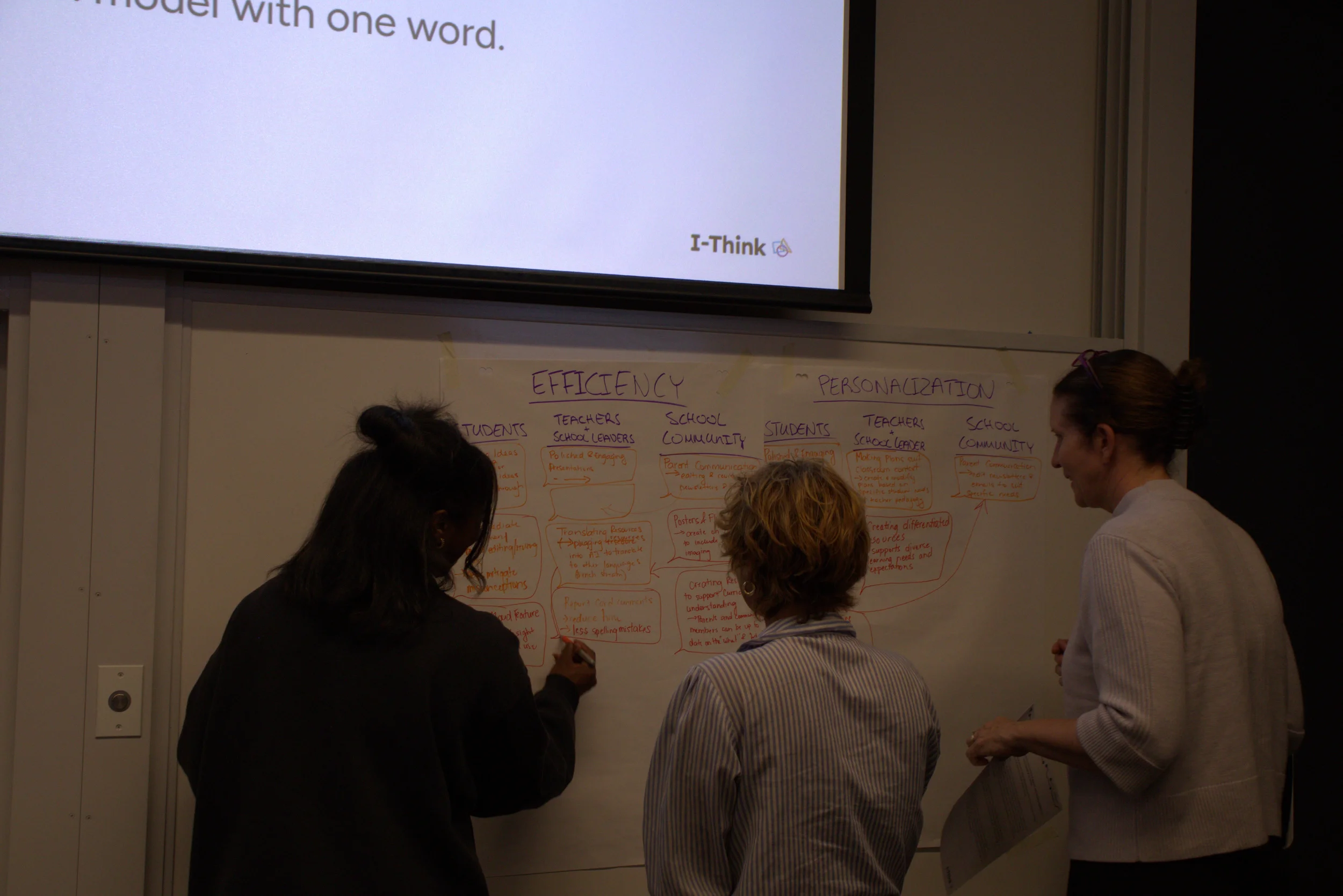
In small groups, you’ll work through a real-world problem. This case study is also based on a classroom-community organization partnership.
Navigating Complexity with the Causal Model
The Causal Model stops us from simplifying the problem and our thinking by embracing complexity. Inspired by systems thinking the Causal Model looks at the interconnections of cause and effect.
“What Integrative Thinking offers is an approach to problem solving that, instead of getting overwhelmed by the complexity of the issues, is hopeful about what is possible.”
- Dr. Maria Vamvalis, Teacher


Join the Movement
Raise a generation with the ability to navigate tension.